


That interoperability meaning applies well beyond emergency response: healthcare, defense, and software engineering all depend on the same exchange-and-use principle. Few fields carry higher stakes than public safety, though, where a communication gap of even a few minutes can change an outcome.
In this article, we look at how public safety agencies define and measure interoperability, the barriers that most often get in the way, and how Smart CAD supports it in daily dispatch operations.
For background on how dispatch platforms work more broadly, our guide to computer-aided dispatch covers the fundamentals.
Table of Contents
What Interoperability Actually Means
In practice, interoperability comes down to one test: can a system hand off information to another system and have it actually get used, without someone manually re-entering, reformatting, or double-checking it first? Two platforms that can technically pass a file back and forth still fail that test if a dispatcher on the receiving end has to re-type the address, unit ID, or incident type before it’s usable.
The same test applies to voice, not just data. A radio that can technically transmit on a channel another agency’s units can hear doesn’t make the two departments interoperable if they use different codes for the same event, or if the connection only works during a scheduled test and drops out during a real multi-agency incident. The Federal Communications Commission’s own definition, written specifically for public safety radio systems, captures this: interoperable communications should let units from different entities exchange information “in order to achieve predictable results.” Predictable, not occasional.
That’s the interoperability meaning worth testing for, not just the dictionary version.
The Interoperability Meaning That Matters Most in Public Safety
That test looks different depending on the layer of infrastructure involved. In dispatch, it shows up in specific, testable scenarios: can a police CAD system share an active incident with the fire department’s CAD system in real time? Can a patrol radio reach a neighboring jurisdiction’s channel during a mutual aid response? Can a caller’s location data pass cleanly from the network carrier to the call taker to the dispatcher to the responding unit, without someone re-typing an address by hand?
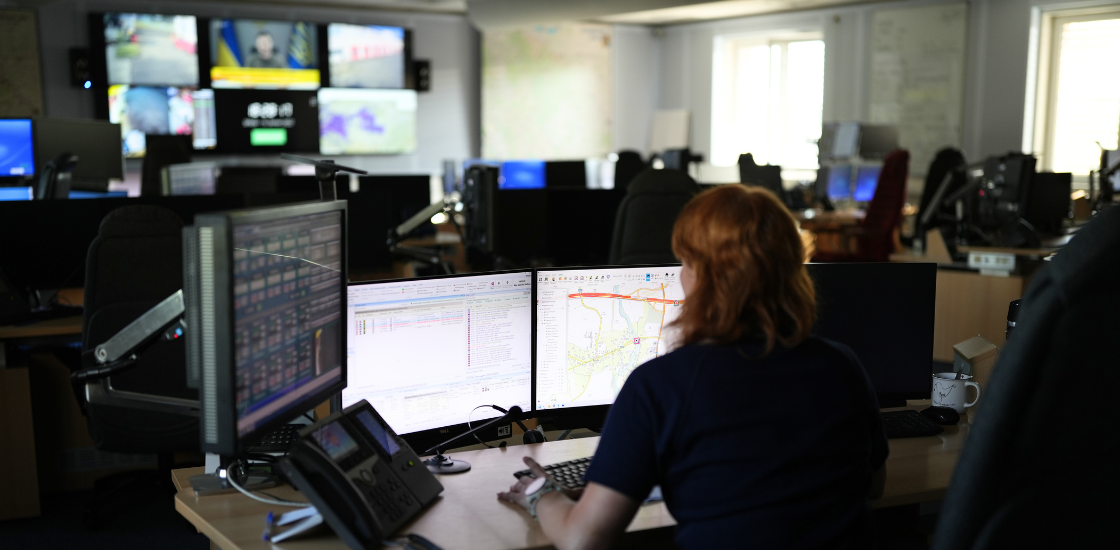
In most countries, dispatch and emergency call centers are organized regionally rather than nationally, and each one tends to manage its own CAD, radio, and mapping technology independently. In the United States alone, the Department of Homeland Security estimates roughly 6,000 such centers operate this way. When neighboring centers run incompatible systems, coordination during a shared incident falls back on workarounds such as phone calls, paper notes, or manual data entry, exactly the failure points that cost time during major incidents.
What Happens When Interoperability Breaks Down
The cost of poor interoperability rarely shows up as a single dramatic failure. More often it is a steady accumulation of small frictions: dispatchers re-keying the same incident into two systems, units arriving at the wrong address because a database updated in one place but not another, or a supervisor learning about a developing incident from a phone call instead of a shared screen. The National 911 Program’s review of CAD interoperability found that the biggest obstacles are rarely technical alone. Slow agency decision-making, a lack of enforced standards, uneven funding, and jurisdictional reluctance to share data all show up alongside the technology gaps themselves.
None of that is a reason to treat interoperability as unsolvable. It is a reason to treat it as a project with several moving parts, not a single software purchase.
Common Barriers to Achieving Interoperability
Agencies evaluating a CAD or communications upgrade tend to run into the same obstacles regardless of size or region:
- Lack of enforced technical standards across neighboring jurisdictions
- No dedicated funding stream for cross-agency system integration
- Reluctance to share incident or records data outside a single department
- Slow governance processes that delay joint decisions on shared infrastructure
- Inconsistent CAD, radio, or mapping capability between agencies that regularly respond together
Addressing even two or three of these before a technology purchase tends to matter more than the specific vendor an agency eventually selects.
How Smart CAD Fits Into the Picture
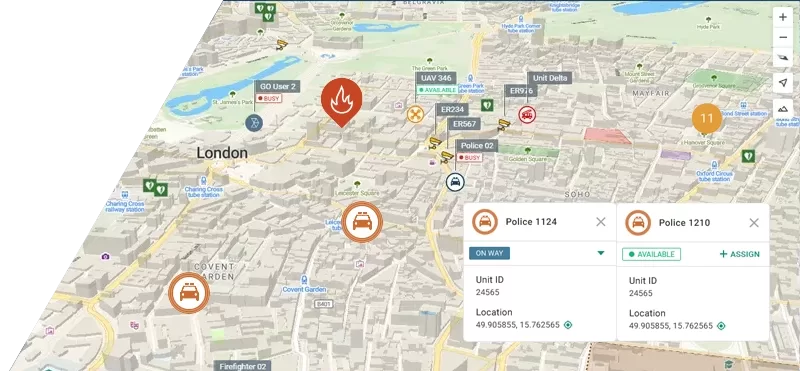
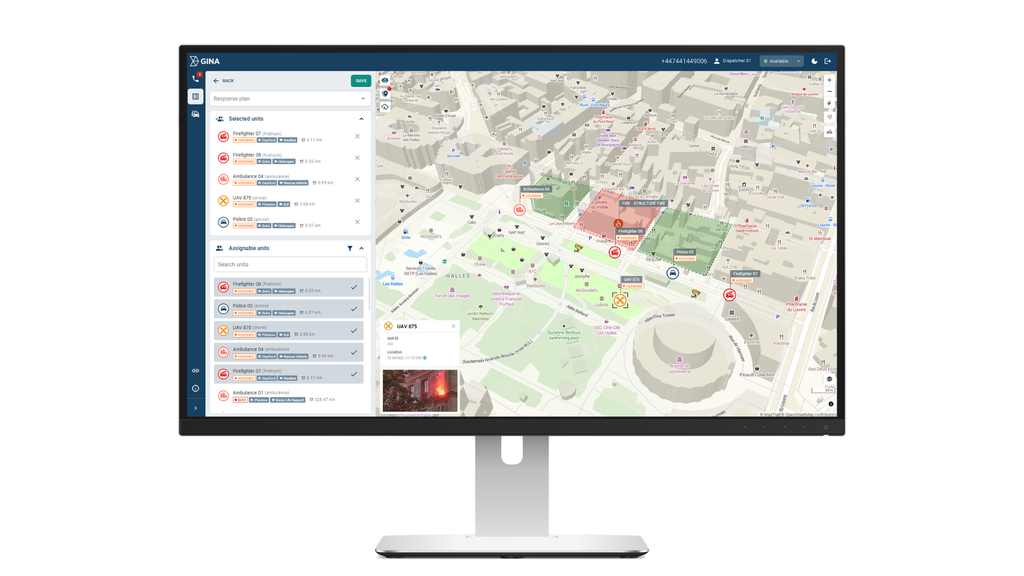
The interoperability meaning we’ve been describing so far is exactly what Smart CAD, GINA Software’s computer-aided dispatch platform, is built around: the assumption that agencies rarely operate alone. It supports multi-agency and multi-jurisdictional dispatch from a single interface, so police, fire, and EMS can view and update the same incident instead of working from separate silos. Machine-learning-assisted unit recommendations help dispatchers select the closest available and appropriate unit during high call volume, which matters as much during a joint response as it does for routine calls.
For situational awareness across agencies, Smart CAD integrates live CCTV streams, wearable camera feeds, and IoT alerts directly into the incident view, so every connected system is working from the same picture rather than a delayed summary passed along by radio. The platform’s Android mobile app gives field units access to shared incident data and turn-by-turn emergency navigation, and its interface is localized across 15 languages, which matters for regions where responding agencies do not all operate in the same language. For agencies that also need shared visibility into vehicle location and status across a jurisdiction, Tactical AVL complements Smart CAD by giving supervisors a real-time map that multiple agencies can reference during a joint response.
None of this replaces the governance, training, and standards work interoperability requires. What it does is remove one common obstacle: a CAD platform that was never built to share data outside its own agency in the first place.
Conclusion
Interoperability meaning is not complicated once you separate the two things it actually requires: systems have to exchange information, and they have to use it once it arrives. Public safety agencies that treat interoperability as a technology purchase alone tend to be disappointed. The ones that also address governance, shared procedures, training, and everyday usage are the ones that get a reliable outcome when it counts, not just a system that looks connected on paper.
Want to see how Smart CAD handles multi-agency coordination in practice? Request a demo, or check out our dedicated page on Smart City Software.