


Selecting a computer-aided dispatch system is one of the most consequential technology decisions a public safety agency makes. The platform sits at the center of how your agency receives, processes, and coordinates emergency response, and it will be in place for years.
If you are currently evaluating CAD platforms and Octave Hexagon is on your list, you may also be curious about what else the market offers. This article covers six alternatives worth considering, what each does well, and a side-by-side comparison to help structure your evaluation.
Table of Contents
Octave, formerly known as HxGN OnCall Dispatch under Hexagon AB, is a computer-aided dispatch platform widely used by large public safety organizations. If you want a deeper overview of the platform before exploring alternatives, read more here: What Is Hexagon Octave and What You Should Know.
What to Look for in a CAD Platform
Before comparing Octave Hexagon alternatives, it helps to be clear on the criteria that matter most for your specific agency. A platform that works well for a large law enforcement agency may not be the right fit for a mid-sized fire brigade or an international humanitarian organization.
- Multi-agency coordination: Essential for shared dispatch centers and mutual aid operations.
- Deployment model: Affects total cost, resilience, and long-term upgrade flexibility.
- Mobile field connectivity: Determines how well units stay connected to dispatch in the field.
- Integration with existing systems: RMS, AVL, mapping, and radio compatibility reduces friction.
- Implementation complexity: Practical path to go-live without disrupting live operations.
- Vendor stability: Long-term reliability matters for mission-critical software.
- Language and localization support: Important for international deployments and multilingual teams.
GINA Software: Smart CAD
GINA Software is a European vendor that has been developing public safety software since 2010, with deployments across more than 50 countries. Its platform was first deployed during the Haiti earthquake response in 2010 and has since expanded to serve fire brigades, EMS, law enforcement, search and rescue, military units, and critical infrastructure organizations worldwide.
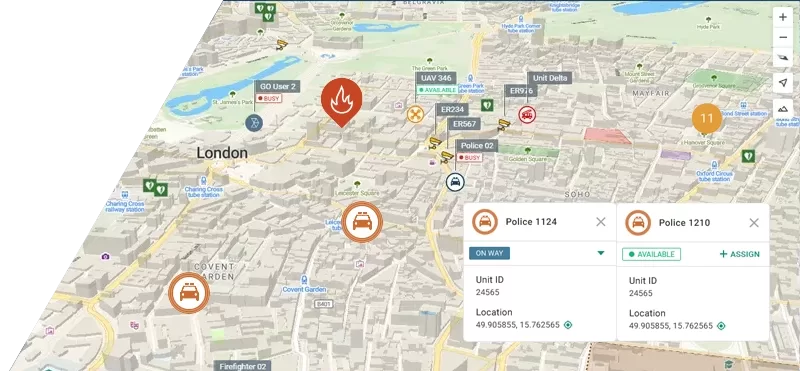
Smart CAD is built specifically for emergency operations and covers the full dispatch workflow in a single platform. Call takers benefit from streamlined intake with ANI/ALI integration and IoT alert reception. Dispatchers get machine-learning-assisted unit recommendations, real-time location tracking, live CCTV integration, and detailed incident logs. Field responders access turn-by-turn emergency navigation, multimedia sharing between units, map annotation tools, and direct access to standard operating procedures from their mobile devices.
Smart CAD supports localization into 15 languages, which makes it a strong option for international agencies and multilingual operations. It is available in both hosted and on-premises environments with Android mobile access.

CentralSquare CAD
CentralSquare Technologies is one of the largest public safety software vendors in North America, serving more than 8,000 public safety and local government agencies. Its CAD platform is designed for high-volume dispatch environments and handles law enforcement, fire, and EMS in a unified interface, with support for multi-agency and multi-jurisdictional operations, integrated mapping, AVL, and 911 call-taking including text-to-911.
CentralSquare CAD is part of a broader public safety suite that also covers records management, mobile reporting, and analytics. Its value compounds when used alongside other CentralSquare products, and the platform is available across cloud, on-premises, and hybrid deployment models to accommodate different agency infrastructure requirements.
Tyler Technologies CAD
Tyler Technologies offers two distinct CAD products. Enterprise CAD is built for mid-to-large agencies with complex dispatch needs, it manages the full incident lifecycle from 911 call through to closure and supports multi-jurisdictional, multi-discipline dispatching. Tyler CAD Pro, part of the Public Safety Pro suite, targets smaller agencies and covers call handling, incident management, real-time mapping with AVL, silent messaging, and dispatch guidance. Both products are available on-premises or cloud-hosted and integrate with Tyler’s RMS and mobile modules.
Agencies evaluating Tyler can choose the product tier that matches their operational scale, with a clear upgrade path if their needs grow over time. The integration between CAD, RMS, and mobile reporting within the Tyler suite means incident data moves consistently across the workflow without manual re-entry.
Mark43 CAD
Mark43 is a cloud-native public safety platform hosted on AWS GovCloud, meaning agencies access it via a standard web browser with no servers to purchase or maintain, Mark43 handles hosting, backups, and updates. Its suite connects CAD, RMS, operational intelligence tools, reporting software, and the OnScene mobile app in a single environment, with data flowing between dispatch and field units in real time. The platform comes in two CAD variants: Primary CAD for day-to-day operations and Alternate CAD as a backup system.
Mark43 is best suited to mid-to-large law enforcement agencies and multi-agency 911 centers that want to move away from on-premises infrastructure or have limited IT resources. Because the platform is fully cloud-based, agencies should confirm that their network connectivity meets the requirements for reliable day-to-day operations.
Omda
Omda is a Nordic software vendor focused specifically on emergency medical services dispatch, with platforms widely deployed across Scandinavia and parts of Europe. Its CAD and command-and-control tools are built around EMS-specific workflows: structured call intake and triage support, ambulance fleet management, real-time unit tracking, and clinical data handoff to receiving hospitals.
Omda is particularly well-suited for EMS-focused agencies, while agencies needing broader multi-agency dispatch coverage should verify fit against their operational requirements.
Zetron
Zetron has built a strong presence in the emergency response and public safety sectors, serving fire, EMS, and law enforcement agencies alongside utilities, transportation, and industrial operations. The company’s solutions are widely used across North America, with a growing footprint in EMEA and Australasia.
Zetron’s CAD offering, MAX CAD, is a modular application suite designed with multi-agency use in mind. Its core components – CAD, mobile CAD, advanced GIS management, and AVL – can be bundled together or integrated selectively based on agency needs. MAX CAD also supports Next Generation 9-1-1 (NG911) interoperability. The modular architecture makes it well-suited for growing agencies or multi-agency jurisdictions, and Zetron positions it as a solution with a low total cost of ownership relative to its functionality.
Platform Comparison
| Vendor | Best fit | Deployment | Strengths | Considerations |
|---|---|---|---|---|
| Octave | Large agencies | On-premises or SaaS | Extensive integrations, interoperability, flexible deployment | Higher cost of ownership, operational complexity |
| GINA Software | Small, mid sized, and large agencies | On-premises | 15 languages, rapid learning curve, modern UI, mobile CAD apps, integrations | No cloud option, limited U.S. presence |
| CentralSquare | Agencies of all sizes | On-premises, cloud, hybrid | Comprehensive suite, multiple CAD options, large installed base, industry experience | Mixed user feedback on support and training, potentially costly for mid sized agencies |
| Tyler Technologies | Small to large agencies | On-premises or cloud hosted | Broad integration, multi agency support, large user base, flexible deployment options | Mixed feedback on usability and support, requires investment in training and setup |
| Mark43 | Mid sized to large agencies | Cloud (AWS GovCloud) | Accessible via web browsers, unified CAD and RMS workflows, mobile friendly | Reliant on internet, some stability/bug issues, limited customization |
| Omda | EMS agencies | Cloud or on-premises | Purpose-built for EMS, clinical data handoff | Limited fit outside EMS and core markets |
| Zetron | Mid to large agencies | On-premises | Modular architecture, NG911 support, low total cost of ownership | Modular setup can increase initial configuration time |
How to Choose the Right Platform for Your Agency
Finding the right CAD platform is less about picking the most feature-rich option and more about finding the right fit for your agency’s size, operational model, and existing infrastructure.
Agency size and call volume. Some platforms are designed for small departments with straightforward dispatch needs, while others are built for high-volume multi-jurisdiction centers. Matching system scale to your actual needs prevents overspending on unused capability or running into limitations as your agency grows.
Deployment model. Decide early whether cloud, on-premises, or hybrid delivery is the right fit for your network environment, IT resources, and security requirements. This will significantly narrow your options.
Integration requirements. Verify that any platform you evaluate integrates smoothly with your existing 911 call-taking systems, radio infrastructure, AVL, RMS, and mobile tools. Strong interoperability eliminates data silos and reduces manual overhead.
Total cost of ownership. Licensing is only part of the picture. Factor in implementation, training, ongoing support, integration work, and any migration costs from your current system.
Vendor support and stability. For mission-critical software, the vendor relationship matters as much as the product. Look at uptime guarantees, support response times, and references from agencies of similar size and operational profile.
Conclusion
Each Octave Hexagon alternative covered here serves a different profile of agency, with different strengths across deployment models, scale, regional presence, and operational focus. The most useful evaluations go beyond feature comparisons and include conversations with reference agencies, scenario-based demos, and a clear understanding of what implementation actually involves.
If you would like to see how Smart CAD fits your specific setup, you can request a demo.