


If you have been evaluating emergency dispatch or CAD software recently, you may have noticed the Hexagon name starting to disappear. From product pages to vendor conversations to procurement documents, a new name is showing up in its place: Octave. For fire departments, EMS agencies, emergency communications centers, and law enforcement organizations in the middle of technology decisions, that shift raises real questions.
What exactly is Hexagon Octave? Is it the same company under a different name, or something genuinely new? What happens to existing Hexagon products, contracts, and support commitments? And if you are evaluating platforms right now, does this change who you are actually buying from?
This article answers those questions directly. We cover what Octave CAD is, how the split came together, what it means for public safety software buyers, and what purpose-built alternatives are worth considering alongside it.
Table of Contents
What Is Hexagon Octave and Where Did It Come From?
To understand what Hexagon Octave CAD is, it helps to understand what Hexagon AB was trying to solve with the split.
Hexagon built its business across two fundamentally different worlds: hardware-driven measurement and metrology on one side, and enterprise software for industrial and public sector operations on the other. Keeping both under the same roof made sense for a period. Over time, the logic weakened. Software businesses scale differently, get valued differently by investors, and require a different strategic focus than hardware product lines.
The decision to separate them was announced in June 2025. The software half was given a new name, Octave CAD, and a mandate to operate as an independent, publicly traded company. Mattias Stenberg, who had been running the relevant divisions inside Hexagon AB, was named incoming CEO.
What landed inside Octave was substantial: the Asset Lifecycle Intelligence division, the Safety, Infrastructure and Geospatial division, plus the Bricsys CAD platform and ETQ quality management business. Taken together, that is a company with roughly 7,200 employees and annual revenues close to €1.5 billion, operating at margins that put it firmly in the upper tier of enterprise software companies.
What the Hexagon Octave Rebrand Actually Changes
For existing Hexagon public safety customers, the immediate practical answer is: relatively little in the short term. The flagship OnCall Dispatch platform, previously known as HxGN OnCall, is now rebranded as Octave OnCall. Beyond the name, branding shifts from HxGN to Octave, and support teams operate under a new organizational structure. Underlying software, contracts, and support obligations are expected to continue.
Octave OnCall Dispatch is the specific software product most public safety agencies will be tracking most closely. It is the centerpiece of Octave’s public safety portfolio, and the migration path for agencies currently running on-premises HxGN OnCall systems is one of the more consequential open questions in this transition.
Octave’s stated mission is to become a predominantly SaaS-oriented, cloud-centric provider of digital services, with AI and cloud delivery at the center of its strategy. For agencies currently running on-premises Hexagon CAD systems, the long-term direction of the Octave OnCall platform points strongly toward cloud migration and modernization, especially for new deployments and upgrades. The timeline and cost of that transition remain an open question for most agencies.
Inside the Octave OnCall Platform
Octave OnCall is not a single application but a suite of connected modules, and understanding what each one does helps agencies evaluate the platform more accurately.
At the center is Octave OnCall Dispatch, the computer-aided dispatch and incident management system that most public safety agencies will recognize from the HxGN OnCall era. It handles call intake, unit assignment, and real-time situational awareness for dispatch centers. Alongside it, Octave OnCall Dispatch Advisor adds AI-assisted decision support to the dispatch workflow, surfacing recommendations on unit selection and flagging operational blind spots as incidents unfold.
Records management is handled by OnCall Records, a law enforcement RMS designed to work directly with OnCall Dispatch rather than requiring separate integration work. Octave OnCall Analytics sits across the platform and gives supervisors access to response time data, unit performance metrics, and trend reporting, the kind of output agencies need for after-action reviews and resource planning.
Rounding out the suite: OnCall Security for PSIM and physical security integration, Octave OnCall Connect for real-time data sharing between agencies and external systems, OnCall Field Mobility for mobile access by field responders, and OnCall Planning for staffing and deployment management.
For agencies currently running HxGN OnCall, this is the product family the migration path is built around. The suite is comprehensive, the more relevant question is what the transition costs and timeline look like for your specific setup.
Why This Matters for Procurement
If your agency is actively evaluating CAD or OnCall dispatch software right now, the Hexagon-to-Octave transition is a valid due diligence consideration. Questions worth asking any vendor in this space:
- What is the continuity plan for legacy HxGN OnCall, and how long will on-premises support continue?
- What does the Octave OnCall Dispatch migration path look like, and what will it cost to move?
- How does Octave OnCall Analytics integrate with your existing RMS or field communications systems?
- How does OnCall Planning integrate with your existing staffing and scheduling workflows?
- Under what terms does Octave operate as a data processor for your agency, and how does that change with a cloud deployment?
- How does Octave’s public safety roadmap compare to purpose-built alternatives?
- What are the contract implications if Octave undergoes further restructuring?
These are not hostile questions. They are standard procurement diligence for any platform mid-transition.
Where Octave CAD Fits in the Broader Market
The public safety software market has grown more competitive, with agencies under pressure to move away from fragmented legacy systems toward integrated platforms that connect dispatch, field communications, and situational awareness in real time.
According to MarketsandMarkets, the global public safety and security market is projected to grow from $575 billion in 2025 to $981 billion by 2030, at a compound annual growth rate of 11.3%. Demand for real-time data integration, AI-assisted decision support, and mobile-first operations are among the primary drivers. (Source: MarketsandMarkets, Public Safety and Security Market, 2026)
Octave faces the real challenge of transforming a large, mature portfolio of installed-base products into a competitive cloud offering while keeping existing customers on critical operations running. That is not a trivial task, and the transition period creates natural uncertainty for agencies on legacy HxGN OnCall systems.
What Agencies Evaluating Alternatives Should Know
Whether you are currently on a Hexagon system or starting a fresh evaluation, the Octave transition is a good moment to look at what else is available. The market has more options than it did even a few years ago, and several platforms are worth a direct comparison.
Whether you are based in the United States or running operations internationally, the platforms below represent the most commonly evaluated alternatives in the public safety space.
| Vendor / Product | Strengths | Best fit |
|---|---|---|
| GINA Smart CAD | Localization into 15 languages, fast onboarding, modern UI, mobile CAD apps | Small to large companies, international deployments |
| Mark43 CAD | Accessible via web browsers, unified CAD and RMS workflows, mobile friendly | Mid sized to large agencies |
| CentralSquare CAD | Comprehensive suite, multiple CAD options, large installed base, industry experience | Agencies of all sizes |
| Tyler CAD | Broad integration, multi agency support, large user base, flexible deployment options | Small to large agencies |
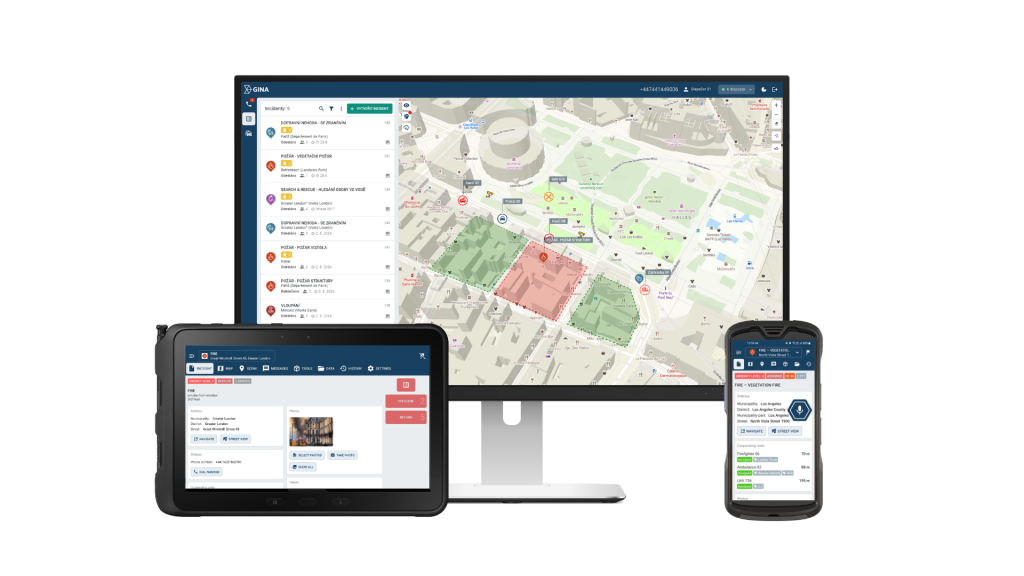
Smart CAD by GINA Software is built for dispatchers, field responders, and supervisors. It streamlines emergency call intake, uses machine-learning algorithms to suggest optimal unit assignments, and gives dispatchers real-time location tracking and unit status monitoring. Field responders get turn-by-turn navigation, live CCTV access, and the ability to share images and video with cooperating units.
Conclusion
The Hexagon-to-Octave transition is still unfolding. For agencies already on HxGN OnCall systems, the practical advice is simple: stay informed, review your contracts, and ask direct questions about what the roadmap looks like for your specific deployment.
For agencies that are starting a new evaluation or planning an upgrade, this is actually a good time to look broadly at the market. The public safety software space has matured significantly, and there are platforms today that were not viable options five years ago.
The right choice depends on your agency’s size, operational model, existing infrastructure, and how much implementation complexity you can absorb. What matters most is that the platform you choose can perform reliably when it counts.
If you are exploring modern alternatives, Smart CAD is worth including in your evaluation. You can request a demo to see how it fits your specific operational setup.